IPAR Speaking & Sessions
Turning information into public understanding — without distortion.
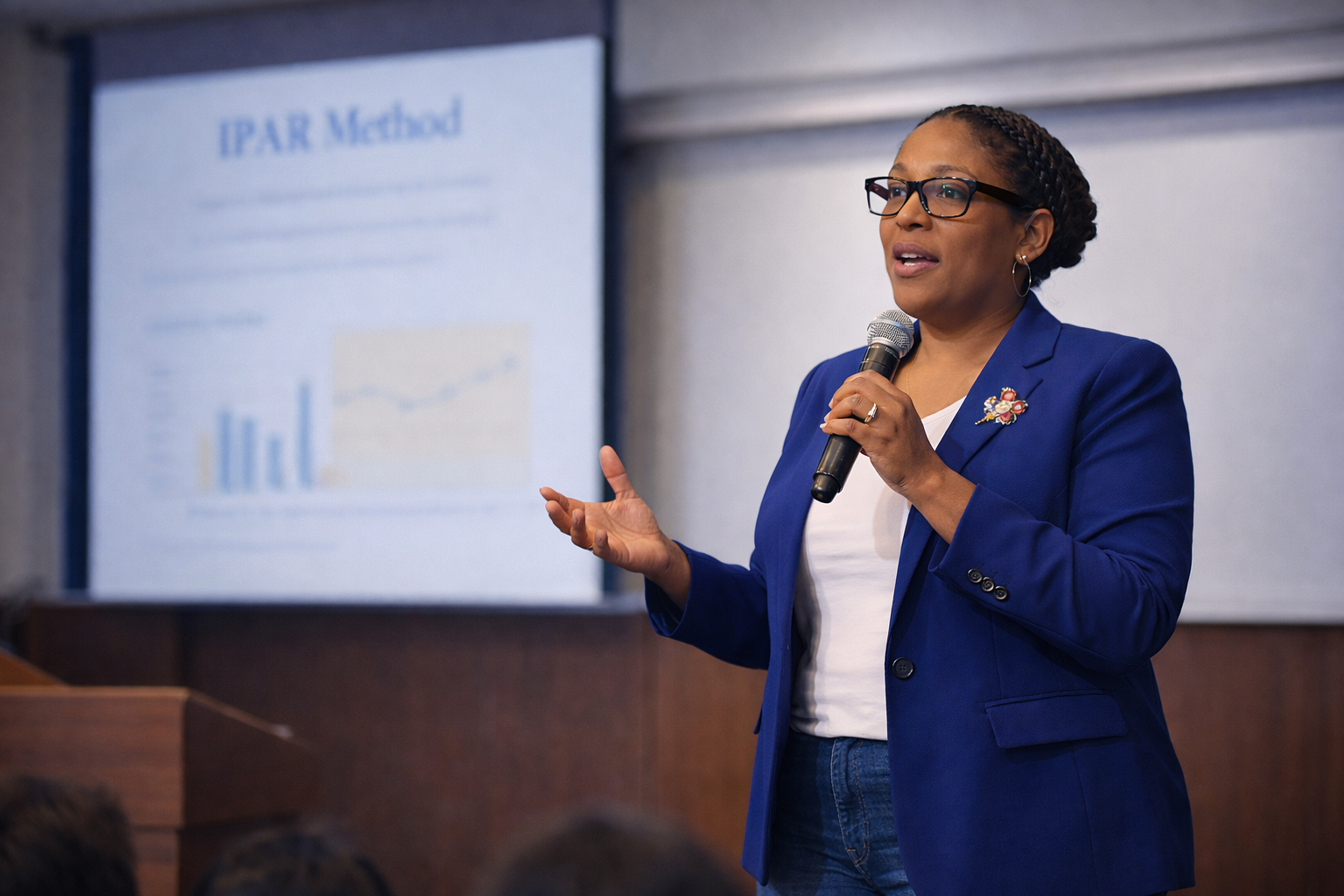
What audiences leave with
- A repeatable way to interpret complex topics without oversimplifying
- A clear boundary between claims, evidence, and meaning
- Language that improves comprehension for non-technical audiences
- A practical model for “what this means” + “what happens next”
The core talk structure
- 1The translation gap — why information fails to enter public understanding
- 2The artifact — a real before/after example (paper/report/dashboard → IPAR translation)
- 3The method — IPAR explained in plain language
- 4Live micro-demo — applying IPAR to a real claim in real time
- 5Adoption — how teams embed an internal “translation step” before release
- 6Q&A — tailored to the audience's field
Formats
Keynotes, interactive sessions, and labs.
45–60 minutes
Keynote / Featured Talk
Best for conferences, university series, campus events, and civic forums.
60–90 minutes
Interactive Session
Audience applies IPAR to a shared example with guided discussion and prompts.
Half-day (3–4 hours)
Implementation Lab
Teams apply IPAR to one real institutional output and leave with a usable translation package.
Suggested topics
- Research-to-Public Translation: why publication is not dissemination
- Media Literacy & Meaning-Making: separating evidence from interpretation
- Data to Narrative: how to communicate dashboards and fact sheets responsibly
- Public Trust: what audiences need in order to understand (not just “know”)
- Policy & Power: connecting issues to decision systems without turning into opinion
Audience fit
- Journalism schools and media programs
- University communications and research centers
- Public health, policy, and evaluation organizations
- Foundations and community-facing institutions
- Civic engagement and media literacy initiatives
Fees (planning ranges)
- Guest lecture / university talk
- $500 – $1,500
- Keynote / featured session
- $2,500 – $6,000
- Implementation lab (half-day)
- $6,500 – $14,000
Final fees depend on format, audience size, prep requirements, and travel. Virtual options available. Travel billed separately if in-person is requested.
Featured keynote
Reviving the Pulse of Journalism: From The Defender to Community Infrastructure
Journalism once functioned as infrastructure.
Publications like The Chicago Defender did more than report events. They translated systems, informed migration decisions, connected families to employment, and helped readers navigate unfamiliar cities with clarity and strategy.
They did not simply circulate information. They organized understanding.
Today, information moves faster than ever. But meaning often fragments.
This keynote revisits the original assignment of the Black press and examines what it looks like to restore journalism as a tool for public understanding, cultural continuity, and institutional literacy. The session draws on historical context and contemporary community realities — including news deserts, public health reporting gaps, and local governance coverage — and demonstrates how structured interpretation strengthens trust and comprehension.
What this talk explores
- Journalism as community infrastructure, not content production
- The migration-era model of translation and coordination
- Where contemporary reporting loses clarity
- The gap between data circulation and public understanding
- The responsibility of journalists to interpret systems, not just events
What audiences leave with
- A grounded understanding of the Black press as strategic infrastructure
- A clearer view of how journalism shapes migration, policy awareness, and civic participation
- Insight into restoring interpretation as a core journalistic function
- A renewed sense of cultural responsibility in media work
Request a speaking engagement.
Share your event date or window, audience type and size, preferred format, and any community issue or artifact you'd like incorporated.